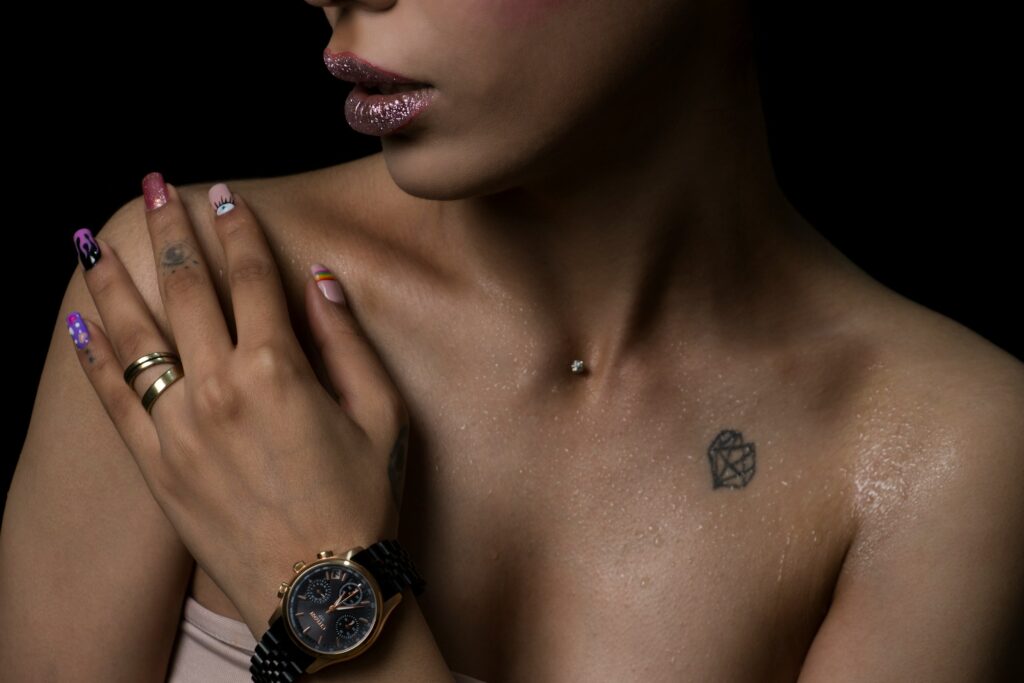
Do you often look at Instagram photos and see a gem hanging right on a person’s skin with no earlobe involved and no visible point of entry? That’s called a dermal piercing, which is one of the most interesting body modifications that you could have.
But before you rush to have your dermal done, you need to know the details. In this article, we are going to cover all aspects including what exactly is a dermal piercing, its pain levels, aftercare, jewelry, etc.
So, let’s start.
What Is a Dermal Piercing?
Dermal piercings are surface piercings where there is only one point of insertion. As opposed to standard piercings where there is a needle that goes into one part of the skin and comes out the other side. A dermal piercing remains below the skin’s surface. Only the decorative top is visible.
They are also referred to as micro dermal or skin divers. The anchor is set just below the surface of the skin and the top which could be in the form of a gemstone, a disk, or any other shape is flat against the skin surface.
Dermal piercings can be done on any part of the body. Some common locations are the collarbone, cheek bone, chest, wrist, lower back and fingers.
This is the reason why dermal piercings are so special. They’re not limited by anatomy the way ear or nose piercings are.
How Does a Dermal Piercing Work?
In a professional piercing procedure, a small pocket is formed on your skin through the use of a dermal punch or a needle. The anchor is inserted underneath your skin. Over time, your tissue will grow through these holes and keep the anchor in place.
The visible end either screws or snaps into the anchor and you can always change your jewelry once you’re healed completely.
That’s why dermal piercings appear as if they’re just sitting on your skin. There’s no straight bar running through. Just the anchor sitting underneath your skin and your jewelry above it.
For this type of piercing, it’s always important to visit a professional piercer. Placement is extremely crucial when it comes to dermal piercings. Wrong placement results in rejection.
How Much Does a Dermal Piercing Hurt?
Pain is subjective. However, most individuals give their dermal piercing a rating of 4 to 6 on a scale of 10.
The procedure is fast. A dermal punch is done within seconds. You will feel pressure, a stinging sensation, and the procedure is over. The discomfort experienced in the following days is bearable.
Location determines how much you will feel the pain. Harder regions such as the collar bone or sternum will result in more pain than fleshier parts like the cheek or hip.
If you’ve already gotten a helix piercing or a rook piercing, you’ll have a good idea of what to expect. Dermals sit in a similar pain range.
How Long Does a Dermal Piercing Take to Heal?
Healing process ranges from 1 to 3 months on the surface while internal healing may take up to 6 months.
Let me provide you with a general outline:
First two weeks: You may experience inflammation, discoloration, and sensitivity of the area – that is totally normal, the anchor is getting adjusted.
Third-sixth week: Inflammation diminishes; the piercing begins feeling more secure. There might be some crusting around the base of the piercing; clean it carefully.
Second-third month: The piercing seems to be healed. However, the anchor is working inside your body, don’t replace the top just yet.
Fourth-sixth month: The healing process is complete, it’s safe for you to change the top.
The healing process depends greatly on individual factors.
Dermal Piercing Aftercare: What You Must Do
Aftercare is mandatory. It determines whether you will have a gorgeous and long-lasting piercing or a rejected or infected piercing.
Adhere to the following instructions:
- Clean twice a day using sterile saline spray. No alcohol and no hydrogen peroxide; they are way too strong and slow the process.
- Do not touch with unwashed hands. Never.
- Protect from snagging on clothes, towels, sheets. This is the most common source of bumps.
- Maintain distance from any make-up and skincare products for at least 2 months.
- Absolutely no pools, hot tubs and open water until fully healed. Bacteria are your enemies at the moment.
- No rotating or pressing the jewelry; let it sit in peace.
In case of growing pain, pus-like discharge or warmth near the pierced area more than two weeks after the procedure, seek help. Early infection can be treated. Untreated, infection cannot.
Dermal Piercing Jewelry: What Are Your Options?
The base is called the anchor. The anchor can be fabricated from titanium or surgical steel that are both biocompatible, so the chances of rejecting the material are minimized.
Concerning the choice of materials for the top part, it is only limited by your imagination:
- Flat disks — minimal and sleek
- Gems and crystals — opal, cubic zirconia, sapphire
- Shaped charms — stars, hearts, moons, flowers
- Solid gold tops — for a luxury finish
Keep it simple. Small and smooth flat top gem will work well during the healing period. You can experiment when you heal.
Material quality is key. Do not skimp on this. Poor-quality metal irritates, leads to allergies and accelerates rejection process.
Dermal Piercing vs. Other Piercings — How Does It Compare?
Dermal piercings are fundamentally different from traditional piercings. Here’s a quick comparison to help you understand where they fit.
Dermal vs. Ashley Piercing: An Ashley piercing passes through the lip and exits inside the mouth. A dermal sits anchored in the skin with no exit point. Totally different placement and technique.
Dermal vs. Conch Piercing: A conch piercing goes through the cartilage of the ear. Dermals can go on the ear too — but they anchor into skin, not cartilage.
Dermal vs. Helix or Rook: Cartilage piercings like the helix and rook pass through a defined piece of cartilage. Dermals are flexible — they go anywhere on the body with enough flat skin.
The biggest difference with dermals? Removal is more involved. A traditional piercing can be removed at home. A dermal anchor needs a professional to remove it safely.
Dermal Piercing Rejection: What to Watch For
The most common problem associated with dermal piercings is rejection. Rejection occurs when your body recognizes the anchor as a foreign object and starts pushing it closer to the surface of your skin.
Look out for these signs:
- The jewelry appears to be migrating — sitting higher or angled differently than before
- The skin over the anchor looks thinner or more transparent
- The anchor feels loose
- You see increasing redness or scarring around the base
If you notice any of these, don’t wait. According to Healthline, piercing rejection can happen weeks, months, or even years after getting pierced — catching it early is key to minimizing scarring.
The rejection risk becomes greater due to incorrect placement of the anchor, the use of cheap jewelry and injury to the piercing area. This is why piercer experience matters so much.
Can You Remove a Dermal Piercing?
Yes – but not at home.
The piercer makes a tiny incision in the skin and lifts the anchor out with the help of a blade. It is a fast process and causes little pain. There might be some scaring too, depending on how long the piercing has been there.
When getting a dermal for an occasion – such as a wedding – keep in mind that after removing it there will be a scar left behind. Plan accordingly.
How to Style a Dermal Piercing
This is when dermals come into their own glory. They are extremely versatile.
Collarbone dermal can add flair to your off the shoulder tops and plunging neckline designs. Cheekbone dermal can work well with bold eye makeup looks. Chest dermal is amazing with any and all attire.
Combine your dermal piercings with body piercings to create a more polished look. A cheekbone dermal piercing together with a helix ear stack will result in a perfect look. Wrist dermal goes well with bracelets.
Treat yourself to a dermal piercing the way you treat yourself with clothing.
Is a Dermal Piercing Right for You?
Dermal piercings are a big commitment. They require a lot of patience when healing, maintenance, and proper skills on the part of the piercer.
However, if you want to have a piercing that goes beyond the basic “in and out” concept, then you really have to get a dermal. It’s the most elegant way to do this.
Get your facts straight, get yourself a professional piercer, buy good jewelry, and maintain the aftercare properly. And you’ll have a piercing that’s as durable as it is beautiful.
Ready to explore more piercing options? Check out our guides on Ashley piercing, conch piercing, rook piercing, and helix piercing to build your perfect piercing aesthetic.