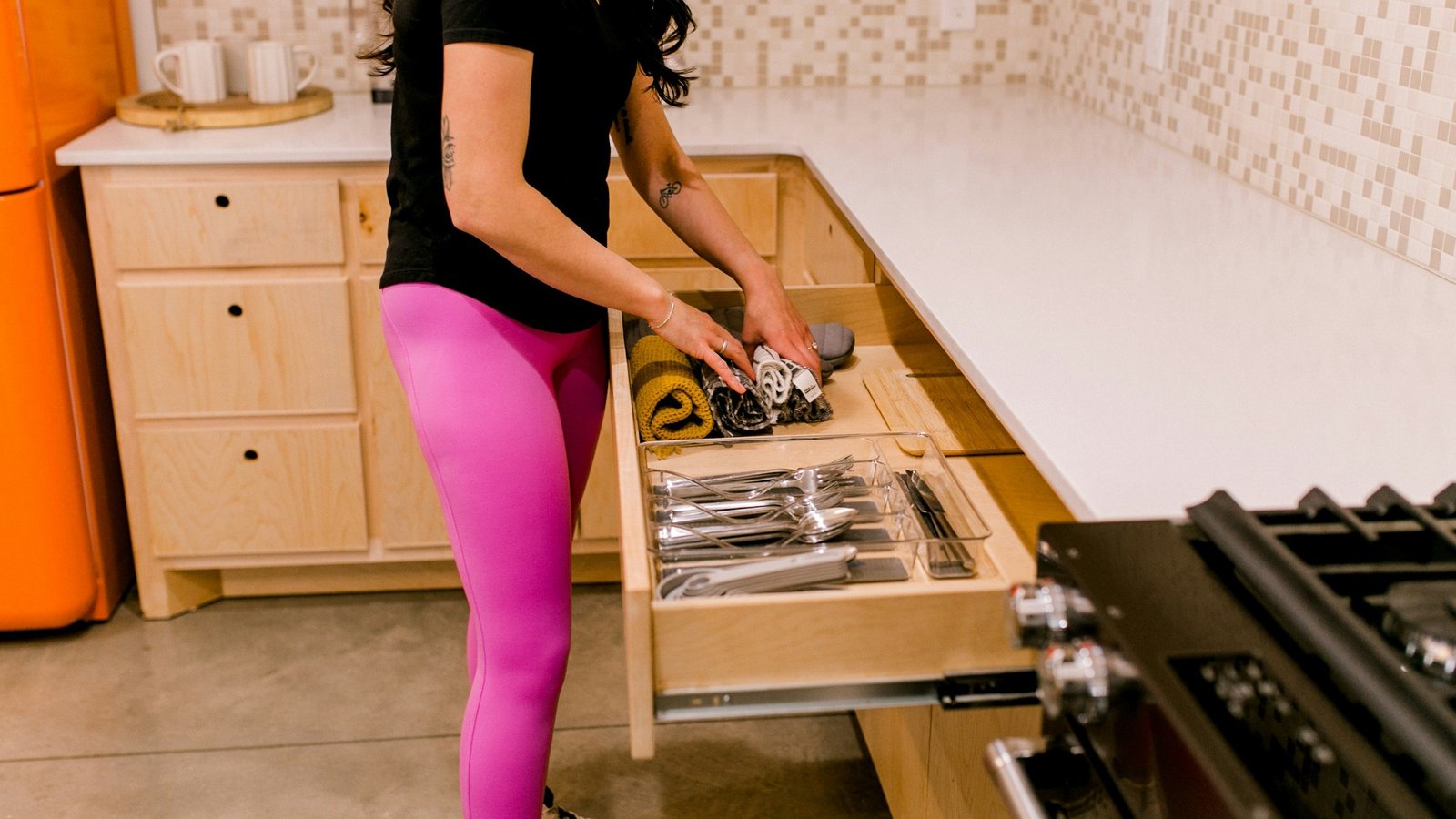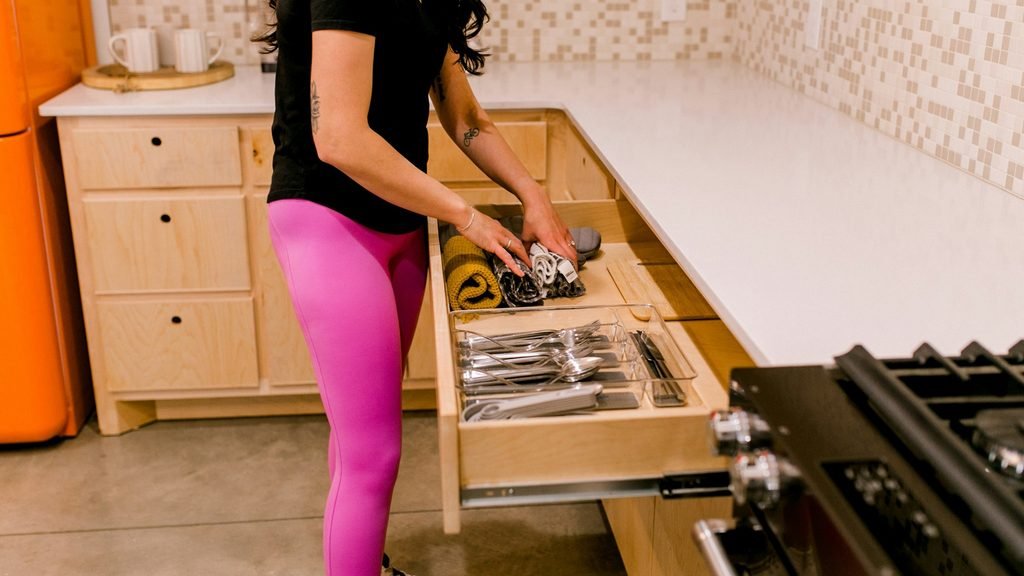
To organize kitchen drawers, empty one drawer at a time, sort what comes out by task, and keep only what you actually use. Then give each group its own divider or tray, and put the things you grab daily in the drawers closest to the stove and prep space. The rest of this guide goes drawer by drawer.
Most kitchen drawers turn into a mess for the same reason. Things get dropped in wherever there’s room, and nothing has a fixed spot. Fixing that takes an afternoon, and you don’t need to buy a full set of organizers to do it.
Decide what lives where first
Before you begin organizing any drawers, consider where you work within your kitchen. You cook at the stove, you prepare food at your main counter, and you clean dishes at your sink and dishwasher. Every drawer needs to store what you need while standing in its location.
The drawers that sit beside your stove are perfect for spatulas, ladles, tongs, and oven mitts. Drawers located near your main counter are suitable for knives, peelers, and measuring cups. Cutlery should be stored near the dishwasher or the dish cabinet; that way, unloading takes two or three steps instead of a whole tour of your kitchen.
Now you may begin organizing one drawer at a time. Take everything out of the drawer and place it on the counter. Tackling the entire kitchen all at once results in having nowhere to work and the probability that you will give up in the middle of sorting. Make three categories as you organize: keep, relocate, and throw away or donate. Four wooden spoons in your possession, when you only use one, means the others should be discarded. The garlic press you’ve used once can go too.
The utensil drawer
This is the drawer you will use most, and therefore it is the one which deserves the best position, ideally next to your stove. Choose a tray that has wider slots. The spatulas, whisks, and ladles are long and bulky, and the narrow slots will cause them to overlap each other.
Sort the tools based on their function. The stirring and flipping tools may be stored in one slot, the whisks and tongs in another, and the smaller tools such as can opener and the peeler in the short slot at the front. Tools that require both hands to remove them from the drawer are too big for the drawer. Put them in a crock on the counter or hang them on the rail.
The cutlery drawer
A tray cut to the size of the drawer does most of the work here. Give forks, dinner knives, and spoons their own slots, and let teaspoons and tablespoons share one. If there’s room left over, add a small section for serving spoons, chopsticks, and straws so they stop wandering into the utensil drawer.
Put this drawer close to the dishwasher or the dish cabinet. Once the tray is in, you’ll find that putting clean cutlery away takes about thirty seconds.
Knives
Loose knives rattling around in a drawer dull quickly, and they’re easy to cut yourself on when you reach in without looking. If your knives live in a drawer, use an in-drawer knife block, a tray with slots, or blade guards that slide over each knife. Keep them in the drawer nearest your prep counter so you aren’t carrying a chef’s knife across the room.
If you already keep your everyday knives in a block on the counter, the drawer can hold the ones you rarely reach for, like a carving knife or a cleaver.
Spices
Heat and light wear spices down, so a drawer is a better home for them than a rack above the stove. Lay the jars flat with the label on the lid, which lets you read every one when you look down into the drawer. If your jars are tall, an angled or tiered insert shows all the labels at once.
Sort them in a way you’ll keep up. Some people group baking spices together and everyday savory spices together, and others go alphabetical. Either works if you stick with it. While you’re in there, smell anything that’s been sitting for years. If it has no scent left, it’s not adding anything to your cooking, so toss it.
Pots, pans, and lids
Deep drawers can hold pots and pans, which frees up cabinet space. Stacking them scratches the surfaces and makes a racket every time you open the drawer. A pan rack fixes that, and so does a thin piece of felt or a paper towel between nested pieces.
Put the heavy items in the lowest drawers so you aren’t lifting a cast iron skillet to waist height every night. Lids are the hard part. A lid rack or a vertical divider keeps them upright and easy to find. Match each lid to its pot before you start, and get rid of any orphans.
If your drawers are shallow, badly built, or hard to reach into, pull-out drawers and corner storage are among the cheaper upgrades to make. We covered that in our guide to a luxury kitchen remodel on a budget, and it’s worth a look if you’re thinking about changing more than the organizing.
Towels, foil, and wraps
Fold dish towels in thirds and stand them on their edge, the way you’d file papers. You can see every towel at a glance without digging through a stack. Foil, parchment paper, and plastic wrap boxes fit well in a shallow drawer on their own. Food storage bags can go in a section with the zip edges facing up so they don’t slump into a heap.
The junk drawer
Every kitchen is filled with one thing that no one ever gets rid of. You will never succeed in getting rid of it. Therefore, try to set boundaries for it. Take all of its contents out on the counter, and discard all of the useless things, including broken pens, outdated coupons, and any key you can’t match to a lock.
However, only those items should remain in it that you use regularly, including scissors, tape, batteries, flashlight, small screwdriver, rubber bands, and a lighter or matches. Store everything separately, in small containers, in order to avoid mixing them again. All the items not intended to stay in the kitchen go to their places.
What to use for dividers
You don’t need a matching set. Measure the inside width, depth, and height of each drawer before you buy anything, because a tray that’s slightly too wide won’t let the drawer close. A few options work well:
- Adjustable spring-loaded dividers. They fit most drawers without tools, and they’re a good choice if you rent.
- Trays with fixed compartments. Bamboo or plastic ones suit cutlery and utensils.
- Things you already own. Shoeboxes, small food containers, and jar lids work well for the junk drawer and for small tools.
- A non-slip liner. A thin one underneath keeps trays from sliding every time you shut the drawer.
Small kitchens get the most out of stackable bins and inserts, since every inch of drawer counts. Our small apartment design hacks have more ideas for making limited storage work.
Keeping them organized
Drawers will revert to disorder unless there is a policy to govern them. The simplest of these is a policy of in and out. Every time you get a new gadget in the drawer, one gadget goes out. Every couple of months, set aside five minutes for the reset process. Remove anything that shouldn’t be there, clean out the drawer, and put all the things in their rightful section.
You can even use tiny labels along the edges of the tray to prevent other people in your home from putting dishes into the spice drawer. Start by tackling the drawer that frustrates you most. One finished drawer shows you what works in your kitchen, and the rest go faster.