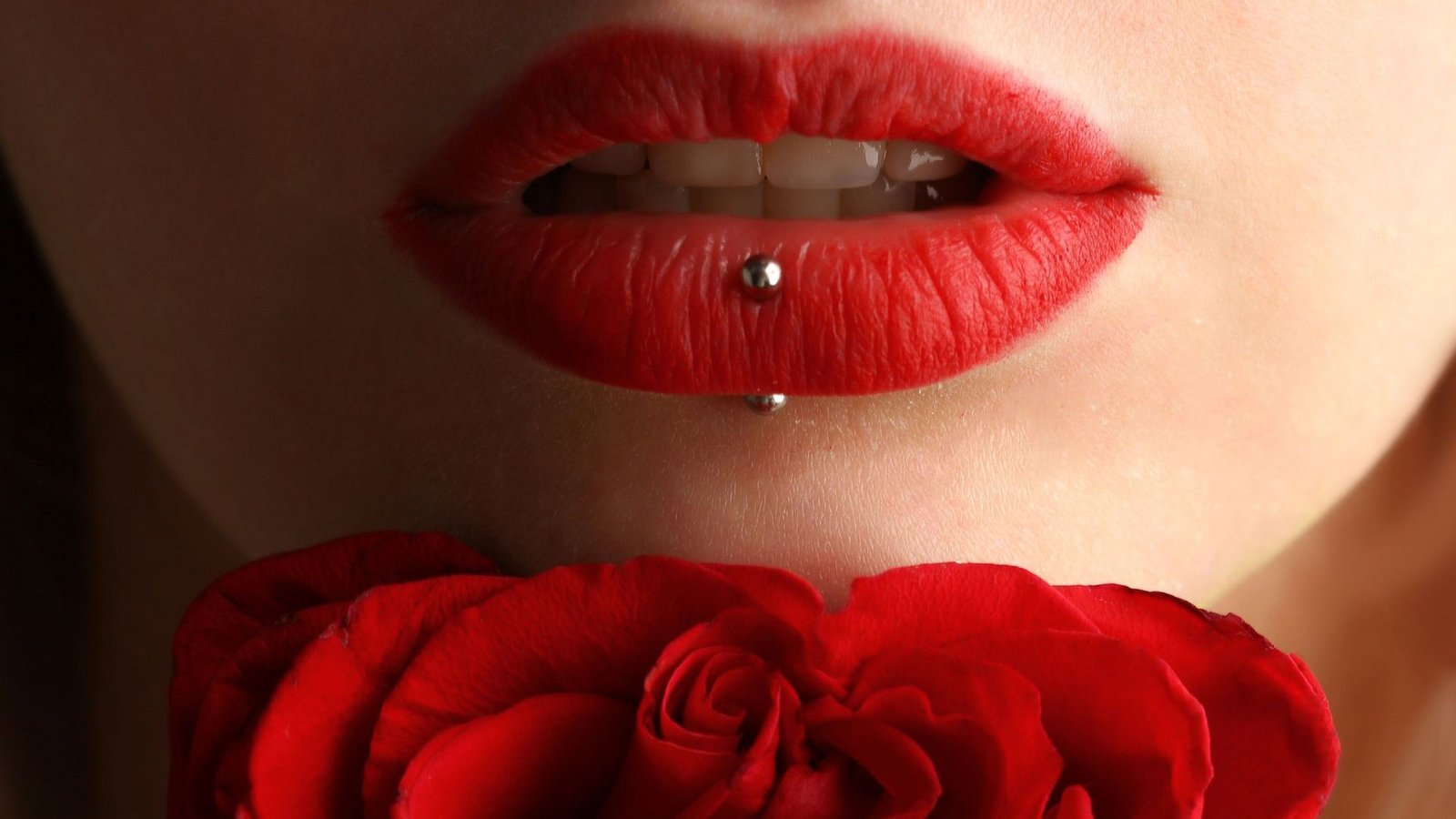
A lip piercing sits on or near the lip, and where exactly it goes changes almost everything about it. The classic labret sits below the center of the lower lip, a Monroe mimics a beauty mark above it, and a Medusa lands in the philtrum. Healing typically runs six to ten weeks with saline rinses and minimal handling, though the exact timeline depends on the placement and how well you look after it.
How a Lip Piercing Actually Works
Unlike a lobe piercing, most lip piercings pass through skin that sits close to muscle and, in several cases, the inside of the mouth. That’s why a piercer uses a hollow needle rather than a piercing gun for any lip placement — a gun can’t safely clear the tissue thickness or account for the angle needed near the mouth. The piercer marks the spot first, checks it against your bite and lip shape while you’re upright, then pierces and inserts the jewelry in one motion. Initial jewelry tends to run slightly longer than what you’ll wear later, since the area swells for the first few days.
Types of Lip Piercings
Labret
The labret is located at the center of the lower lip, between the lip and the fold of the chin. This piercing is very popular because it can be done on almost all faces, and the jewelry that can be worn includes small hoops and flat-back jewelry. Off-center labrets are common too, placed to one side rather than in the middle.
Vertical Labret
Instead of entering from the front, a vertical labret enters through the top of the lower lip and exits lower down, so the visible jewelry is a small curved barbell with both ends showing on the outer lip. A related version, the Ashley piercing, enters the same way but the bottom bead sits inside the mouth against the front teeth rather than exiting externally — we cover that placement, its jewelry needs and its specific aftercare challenges in a dedicated Ashley piercing guide, since it behaves differently from a standard lip piercing once it’s healed.
Monroe and Madonna
Both sit above the upper lip, off to one side, styled after a beauty mark. A Monroe goes on the left, a Madonna on the right. They’re usually done with a flat-back stud so the jewelry sits close to the skin.
Medusa (Philtrum)
The Medusa goes through the philtrum, the vertical groove between the nose and the center of the upper lip. It sits closer to the nose than a Monroe or Madonna and tends to draw more attention to the cupid’s bow.
Snake Bites and Dolphin Bites
Snake bites are two piercings placed symmetrically on either side of the lower lip, spaced a small distance apart. Dolphin bites use the same idea but placed closer together, centered under the lip. Both usually involve two separate healing periods happening at once, which takes longer overall than a single piercing.
Dahlia
A dahlia piercing sits at each corner of the mouth, meant to extend the line of the lips when you smile. It’s one of the more demanding placements to heal because the corners of the mouth move constantly with eating and talking.
Choosing a Placement
Pain tolerance matters less here than people expect — most lip piercings involve a quick pinch rather than sustained pain, since the needle passes through soft tissue rather than cartilage. What matters more is daily life. A labret rarely interferes with eating or talking once healed, while a dahlia or snake bites can take longer to feel normal because the mouth is constantly moving. If you’re weighing a lip piercing against a cartilage piercing like a helix or conch, know that cartilage generally heals slower and is more prone to complications if it’s bumped — our guide to ear piercing types covers the differences in more detail if you’re deciding between the two.
Work and lifestyle are worth thinking through too. Upper lip placements like the Monroe and Medusa are more visible and harder to hide than a labret, which some jewelry can make nearly disappear when needed.
Healing Time and What to Expect
Generally, the process of external healing of lip piercings takes between six and ten weeks, while complete recovery, including the reduction of internal swelling and scar formation, may take additional time. During the first week, there will be swelling, tenderness, and discharge, which is colorless or slightly yellow in color and not related to infection by itself. Swelling tends to decrease gradually during the following days; however, if swelling increases, the piercing area becomes hot and painful, this problem needs consultation with your piercer or a medical specialist.
Several lip piercings are located inside the mouth and, therefore, the process of their healing depends more on oral hygiene than that of other piercings. Food particles and bacteria in the mouth can slow healing or cause irritation around the exit point.
Aftercare
Clean the piercing twice a day with a saline solution, either a sterile pre-mixed spray or a mix of non-iodized sea salt and distilled water. Rinse your mouth with alcohol-free mouthwash after eating for the first few weeks, since food debris around the piercing is one of the most common causes of irritation. Avoid touching or twisting the jewelry, and skip the temptation to switch it out early — changing jewelry before healing is complete is one of the more common reasons a lip piercing gets irritated or rejected.
Jewelry and Material
Surgical steel and titanium are the safest starting materials, since they’re less likely to trigger a reaction while the tissue is still healing. Titanium is the better choice for anyone with a nickel sensitivity. Gold is fine once the piercing is fully healed, but it should be at least 14 karat, since lower purities mix in more alloy metals that can irritate healing or sensitive skin. Whatever the material, initial jewelry should have a flat back or a secure closure that won’t catch on teeth or gums, which matters more here than it does for most other piercings.
Finding a Piercer
Lip piercings are a simple process, but you will want to have one performed by a piercer who works in a licensed studio, uses new needles from sterile packages each time, and can discuss how to place your piercing before they make any marks. Anything that seems rushed on the part of the piercer, or if they cannot explain their sterilization process, is enough of a red flag to seek another piercer.