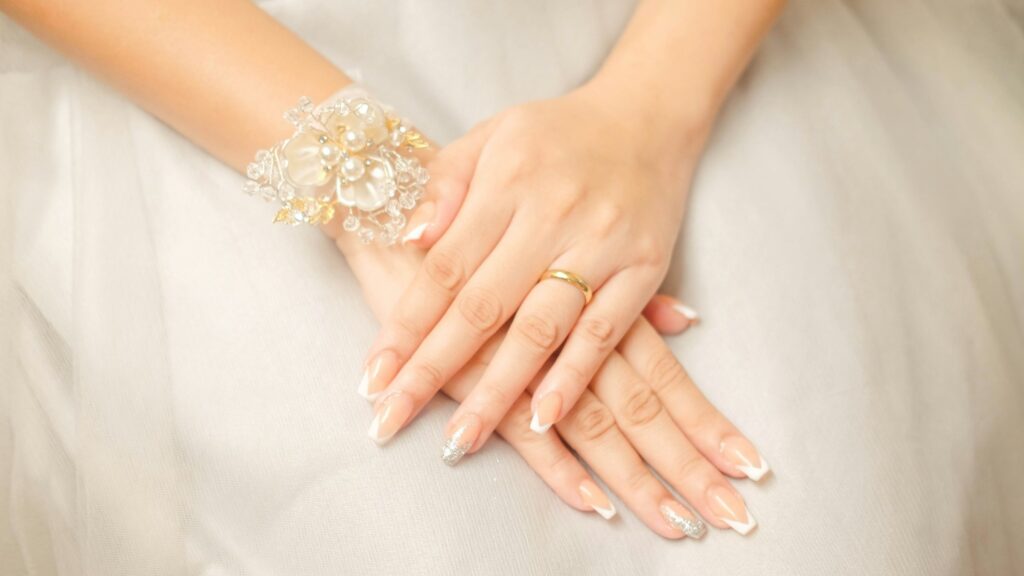
Wedding nails in 2026 come down to three real options: nude, milky, or French. Nude gives a warm, skin-matching base that photographs naturally. Milky offers a sheer, no-mani-mani finish that’s currently the most requested bridal look. French delivers a crisp, classic line that still reads as effortless when the tip is softened. Here’s how to choose between them.
You’ve probably scrolled through hundreds of bridal nail photos by now and ended up more confused than when you started. That’s not your fault. Most wedding nail content is a wall of 50 near-identical images with zero explanation of why any of them would actually suit you, your dress, or your day.
So let’s skip the scroll. There are really only three directions your wedding nails can go, and picking between them is less about trends and more about how your hands are going to spend the day: in ring shots, wrapped around a bouquet, raised for toasts, and photographed more than almost any other part of you besides your face.
The Big Shift: Why “Wedding Nails” Doesn’t Mean What It Used To
A few years ago, wedding nails basically meant one thing: a French manicure, done as classically as possible. That’s changed. Nail artists and bridal stylists have been calling the current mood the “no-mani mani” — sheer, translucent finishes that make your hands look naturally polished rather than visibly painted.
This shift tracks with a bigger move in bridal beauty generally. Skin looks more like skin. Makeup looks more like a good night’s sleep. Nails are following the same logic: understated, well-groomed, and built to photograph well rather than shout for attention.
That’s exactly the territory our deep dive on milky white nails covers — the soft, latte-toned finish that’s become the most-requested bridal look this season, along with how nail techs actually achieve that cloudy, semi-sheer effect without it turning chalky. If milky is where you’re leaning, that’s the place to go deeper on shade, texture, and application.
Nude, Milky, or French: How to Actually Pick
Here’s the part that actually matters — not which look is trending hardest, but which one fits your hands, your dress, and how much upkeep you’re willing to deal with during wedding week.
Nude: The Safest Bet for Every Skin Tone
Nude wedding nails work because they’re designed to complement your natural skin tone rather than compete with it. That’s a meaningful distinction: a nude that’s too pink or too beige can wash you out in photos, while the right shade makes your hands look brighter and healthier without any extra effort.
For fair skin, soft pinks and light beige tend to look the most natural. Medium and olive tones usually suit peachy beige or warm taupe better. Deeper skin tones look richest in mocha, cocoa, or espresso-adjacent shades. If you want the full shade-matching breakdown by undertone, along with nail shape pairings, we’ve covered nude nails in detail elsewhere — it’s also one of the most popular bridal manicure choices specifically because it holds up well across every stage of a long wedding day, from getting-ready shots to the send-off.
Milky: The Trend Every Bride Is Asking For Right Now
If your dress has any texture, embroidery, or lace detail, milky nails won’t compete with it. That’s a big part of the appeal. The sheer, cloudy finish reads as “your nails, but better” instead of a visible manicure, which is exactly why it’s become the most-booked bridal option this season.
It also happens to be one of the most forgiving options if your nail length isn’t perfectly uniform, since the sheerness softens any small differences between nails. The tradeoff is that milky polish shows growth lines faster than darker shades, so timing your appointment close to the wedding matters more here than with almost any other option — more on that below.
French: Classic, But Not the French Tip You’re Picturing
The French manicure never really left bridal beauty, but the version brides are asking for now looks different from the stark white-tip look of a decade ago. Instead of a thick, opaque white line, today’s bridal French tips lean toward a barely-there ivory or soft white edge — closer to a whisper than a statement.
Micro French tips, thin double lines, and softened edges all fall into this category, and they pair especially well with a sheer or nude base rather than the classic clear one. For the full range of French tip variations — including how to keep the line crisp without it looking harsh — we’ve covered the style options in more depth than we have room for here.
DIY at Home or Book a Salon Trial?
This depends heavily on which of the three directions you pick. Milky and nude finishes are genuinely doable at home if you’re comfortable with thin, even coats — the biggest mistake most people make is applying one thick coat instead of two or three thin ones, which is what causes streaking.
French tips are the trickiest to DIY well, since a clean, straight line takes a steadier hand than most at-home manicures require. If you’re set on doing your own for the wedding, we’ve broken down how to get clean French tips at home — the tools and technique that make the line easier to get right without a salon visit.
If your budget allows for it, a salon trial is worth it regardless of which look you choose — mainly because seeing the actual shade against your actual dress fabric, in person, catches mismatches that photos on your phone never will.
Timeline: When to Book, When to Touch Up
Getting the timing right matters more for wedding nails than for a regular manicure, mostly because there’s no room to redo it the morning of.
- 4–6 weeks out: Book a trial appointment, especially if you’re going with milky or a custom nude shade. Bring a swatch of your dress fabric if you can.
- 1–3 days before the wedding: Book your final appointment. This gives your nails time to fully cure and settle without the risk of same-day chips, while still looking fresh for the day itself.
- Day of: Skip the urge to touch anything up yourself. Pack a small emergency kit — a matching polish or a clear top coat — for your maid of honor to handle instead, so you’re not the one doing repairs in your dress.
One more thing worth knowing: however, your wedding nails are done, avoid the temptation to trim your cuticles yourself in the lead-up. Dermatologists’ guidance on cuticle care is clear that cutting them can damage the nail rather than improve it — a gentle cuticle oil in the weeks before is a safer way to get that clean, groomed look without the risk of nicks showing up in close-up ring photos.
Trends We’re Skipping for the Big Day
Not every popular nail trend belongs on a wedding day. Heavy 3D art, chunky gems, and very bold or dark colors tend to compete with the dress and the ring rather than complement them, and they photograph less predictably under flash and mixed lighting than a soft, sheer finish does.
That’s not to say bold nails don’t have their place — they absolutely do, just maybe not for the ceremony itself. If you want inspiration for everything outside the bridal lane, this year’s prettiest nail designs are a better home for those bigger, brighter ideas.
Frequently Asked Questions
Do wedding nails need to match the dress exactly? No. They should complement it, not match it precisely. A warm ivory dress generally pairs better with a soft nude or milky finish than with stark white nails, but there’s no rule requiring an exact color match.
How far in advance should you get wedding nails done? Book a trial 4 to 6 weeks before the wedding, then your final appointment 1 to 3 days before. This avoids both premature growth lines and last-minute rushing.
What’s the most durable option for a full wedding weekend? Gel versions of any of the three looks — nude, milky, or French — tend to outlast standard polish through a multi-day wedding weekend of dancing, champagne, and photos.
The Bottom Line
Wedding nails don’t have to be complicated, even though the sheer volume of Pinterest boards makes it feel that way. Nude gives you warmth and safety. Milky gives you the current trend and a forgiving, photo-friendly finish. French gives you a classic that’s been quietly modernized.
Pick based on your dress, your maintenance tolerance, and how your hands are going to spend the day — not based on which option has the most saved pins. Whichever direction you choose, book it with enough lead time to actually enjoy the process instead of squeezing it in between every other wedding-week errand.