Here’s a strange truth about furniture shopping: the bed frame is the piece we spend the most time touching — a third of our lives, give or take — and yet it’s usually the piece we research the least. We’ll spend an hour comparing mattress firmness levels and then grab the first frame that matches the room’s color scheme.
That’s a mistake, because the wood underneath the finish is doing all the actual work. Two frames can look nearly identical under a store’s lighting and age in completely different ways once they’re home — one because it’s cut from solid oak, the other because it’s a wood-look veneer wrapped around particleboard. If you’ve ever had a bed frame start creaking within a year or two, this is usually why.
This guide walks through what separates a frame that lasts decades from one that doesn’t.
Solid Wood, Veneer, or Engineered Wood — What Are You Actually Buying?
“Wood bed frame” gets thrown around loosely in furniture listings, so it’s worth knowing what’s really under the surface before you compare species.
Solid wood is exactly what it sounds like — the rails, legs, and headboard are cut from real timber all the way through, not just on the surface. It’s the most durable option by a wide margin, and it’s the only one you can sand and refinish years down the line if it picks up scratches.
Veneer is a thin sheet of real wood glued over a plywood or particleboard core. It can look convincing, sometimes indistinguishable from solid wood at a glance. Still, it can’t be refinished more than once or twice, and the edges are more vulnerable to moisture damage — similar to how veneer flooring struggles in humid rooms.
Engineered wood — particleboard, MDF, that sort of thing — skips real wood grain altogether, often paired with a steel frame for extra support. It’s the most affordable route, and to be fair, a well-built, engineered frame with steel reinforcement can genuinely outperform a cheaply made softwood one. It just won’t outlast solid hardwood over the long run.
If longevity is the priority, solid wood earns its higher price tag. If you’re kitting out a guest room or working within a tighter budget, a steel-reinforced engineered frame is a perfectly reasonable middle ground.
Comparing Wood Types for Bed Frames
Not all solid wood behaves the same way under the weight of a mattress, two sleepers, and years of daily use. Here’s how the common options stack up.
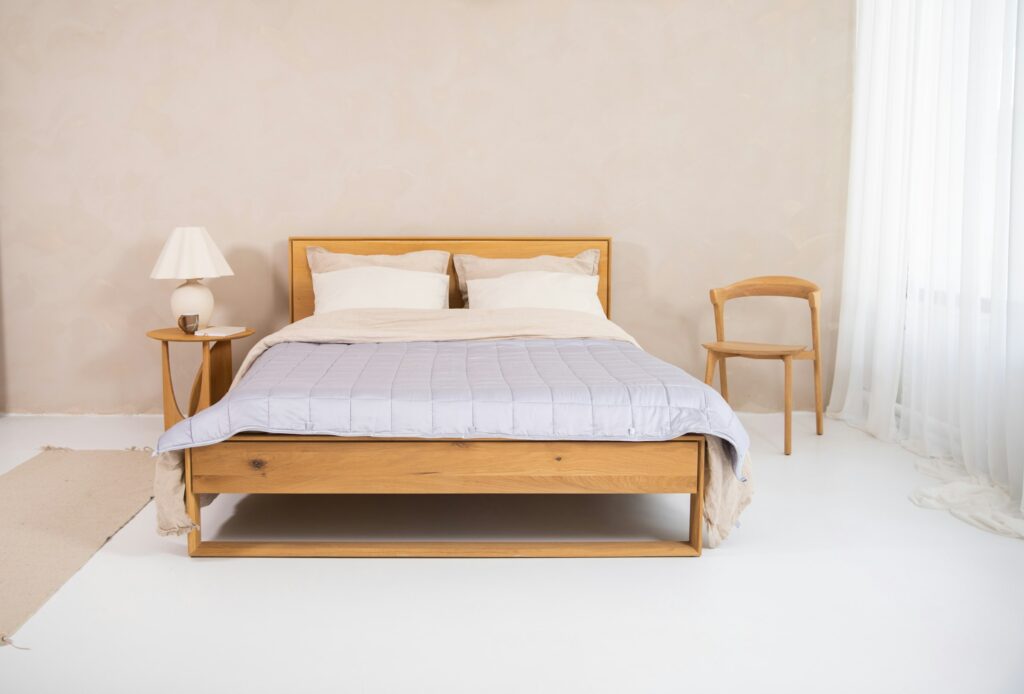
Oak is the default recommendation for a reason. It’s dense, shrugs off dents and moisture, and holds its joints tightly over the years instead of loosening into that familiar squeak. It works in almost any bedroom style — traditional, transitional, modern — and a well-made oak frame will typically go 20 to 30 years before it shows real wear.
Walnut gives up a small amount of raw hardness in exchange for one of the richest, deepest tones in furniture-grade wood. It’s still plenty strong for full bed construction, but most people choose it for how it looks rather than raw durability — that dark, warm grain turns a bed into the focal point of the room instead of just another piece in it.
Maple runs neck and neck with oak on strength, with a cleaner, paler grain that suits Scandinavian or minimalist bedrooms better than oak’s heavier character. It’s a bit trickier to cut and shape during manufacturing, which mostly just means you’ll see fewer highly custom maple designs — not really a downside for the buyer.
Cherry isn’t the hardest wood on this list, but it more than makes up for it with natural decay resistance and a color that keeps evolving — starting light pink-brown and mellowing into a warm reddish tone as it ages. If you like furniture that changes character over the years, cherry does that better than almost anything else here.
Rubberwood has quietly become one of the smarter mid-range picks. It comes from rubber trees after their latex-producing years wind down, so it’s a fairly sustainable material, and it’s tougher than the price suggests — resistant to cracking, with a typical lifespan around 20 years. If oak or walnut is out of budget, this is usually the next best call.
Pine, along with other softwoods, is the cheapest way into a genuine solid wood frame, and it takes stain or paint well if you want to customize it. The tradeoff is real, though — softwoods dent and scratch more easily and typically last 10 to 15 years rather than the 20-plus you’d get from a hardwood. Worth knowing before you commit if you want this bed to outlast a couple of apartment moves.
Poplar sits in similar territory — easy to work with, finishes nicely, budget-friendly, but genuinely soft. Be a little more careful during moves, and keep it away from sharp-cornered furniture nearby.
How Long Should a Wood Bed Frame Last?
As a general benchmark, hardwood frames average 20 to 30 years with reasonable care, while softwood frames last closer to 10 to 15 years. Weight capacity tracks a similar pattern — oak and walnut frames typically hold 600 to 1,000 pounds, while softwood frames are usually rated lower.
But here’s the catch: construction quality can matter more than species. A softwood frame with solid, bolted joinery can genuinely outlast a hardwood frame that was thrown together with weak glue joints. If you’re buying rather than building, check how the rails attach to the frame — bolted connections hold up far better over time than glue alone — and whether there’s center support underneath for queen and king sizes, which take on a lot more flex than they look like they do.
It’s the same logic that applies to a lot of home projects that look simple on the surface but live or die on the details you can’t see once it’s assembled — the way proper insulation matters more than the garage door itself when you’re trying to keep a space usable year-round.
Matching the Wood to Your Bedroom
Want the safest, hardest-to-get-wrong choice? Oak. It balances strength, lifespan, and style flexibility better than anything else here, and it holds up well under heavier mattresses and larger bed sizes.
Want the bed to be the room’s focal point? Walnut. Part of what you’re paying for is durability. Still, a bigger part is simply how it looks in low evening light — a dark walnut frame does a lot of the visual heavy lifting in a bedroom, the same way a well-chosen vaulted ceiling design can define a whole room without needing much else around it.
Working with a tighter budget, but still want real wood? Rubberwood or pine. Rubberwood has the better durability-to-price ratio of the two; pine is the more affordable option, but expect a shorter lifespan in exchange.
Furnishing a smaller room? Think about wood and design together, not separately. A heavy oak platform bed can overwhelm a compact bedroom the way an oversized sectional overwhelms a small living room. At the same time, a lighter-toned wood with slimmer legs reads as far less crowded even at identical dimensions.
Live somewhere humid, or tend to sleep hot? White oak specifically handles moisture and decay better than most alternatives — a small distinction that matters a lot more in practice than it sounds like it should.
Keeping a Wood Bed Frame in Good Shape
A little routine care goes a long way toward hitting that 20-to-30-year mark instead of falling short of it:
- Dust regularly, and skip the harsh chemical cleaners — they strip the natural oils and finish faster than daily use ever would.
- Keep the frame out of prolonged direct sunlight if you can; UV exposure dries out and fades wood over time, the same slow damage that shows up on an unprotected wood deck left exposed to the elements.
- Check and tighten bolted joints every few months. Most of that annoying nighttime squeak comes from loosened hardware, not the wood itself.
- Give solid wood a light polish once or twice a year to keep the finish from drying out and cracking.
- If it does pick up minor scratches, solid wood — unlike veneer — can usually be lightly sanded and refinished instead of replaced outright.
Frequently Asked Questions
What’s the most durable wood for a bed frame? Oak, by a wide consensus — it’s dense, resists denting and moisture, and holds up well over decades. Ash is comparably hard but far less common in furniture.
Is solid wood or engineered wood the better choice? Solid wood wins on lifespan and can be refinished when it shows wear. Engineered wood costs less upfront and, paired with steel supports, can still hold up reasonably well for several years — just not indefinitely.
Does the wood type actually affect whether a frame squeaks? Yes, more than most people expect. Woods with lower dimensional stability shift slightly as humidity changes, which is often where squeaking starts. Denser hardwoods like oak hold their shape — and stay quieter — much better than softwoods.
How can I tell if a frame is real wood or just veneer? Check an edge or the underside. Solid wood shows consistent grain running all the way through; veneer shows a thin, uniform layer sitting over a different-colored core, usually particleboard.
The Bottom Line
There’s no single best wood for every bedroom — it really does come down to your budget, how long you want this frame to last, and how much visual presence you want it to have in the room. But if there’s one thing worth remembering, it’s this: solid wood, tight joinery, and a species suited to your climate will outlast whatever’s trending this year, by a long shot.